
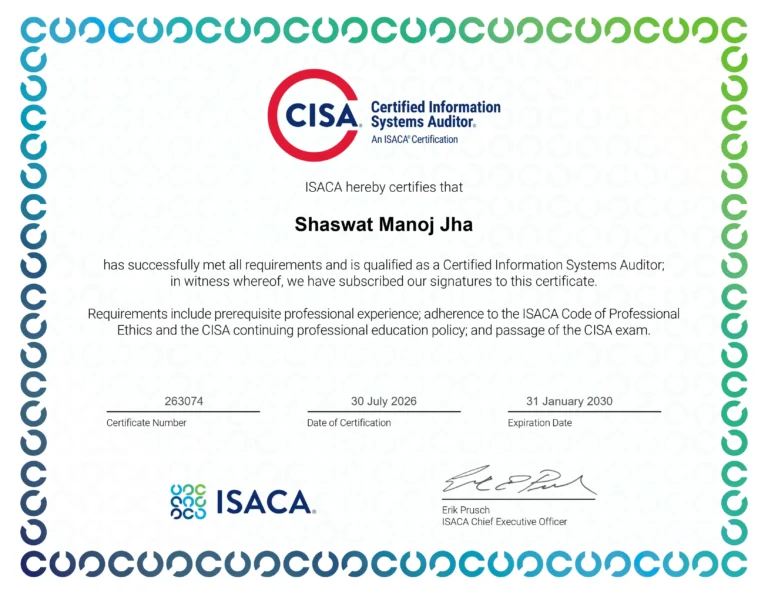
My CISA Preparation Strategy – The Mindset Shift That Made Everything Click
Disclaimer: I used an LLM to help structure and rephrase the text, but everything mentioned is my own original work written without any external references or sources.
When I was preparing for CISA, I often found myself answering like an engineer instead of an auditor. This is a collection of my personal study notes, not some brain dump or leaked exam content and absolutely not a replacement for the official CISA Review Manual or QAE.
This guide covers 23 exam heuristics – from accountability hierarchies to root-cause analysis to reading ISACA’s exact command words – that reframe how you approach four-option questions where at least two answers look technically correct.
This is not a textbook chapter, or a CISA course. It’s the stuff I wish somebody had explained to me while I was sitting and staring at CISA questions where at least two answers looked technically correct and I had to pick the BEST / MOST / FIRST one.
Note that these are exam heuristics, not laws of physics. So, read the exact wording in exam. ISACA would change one word and make your shortcut completely useless.
These are the notes I kept coming back to during preparation.
What is the CISA exam mindset?
The CISA (Certified Information Systems Auditor) exam tests whether you think like an auditor – someone who evaluates, reports, and recommends – rather than an engineer who jumps straight to fixing things. That distinction helped me make sense of questions where several answers looked reasonable.
1. Accountability usually floats upward
When a question asks who is ultimately accountable for governance, enterprise risk, or alignment of IT with the business, look toward the Board of Directors or the highest governing body in the options.
The key word is ultimately .
Responsibility can be delegated. Work can be assigned. Committees can monitor things. Management can implement everything. But the highest-level accountability normally stays with the governing body.
That does not mean “Board of Directors” is the answer to every question containing the word accountability. Ask what level the question is testing:
- Who provides governance and oversight? Probably the board.
- Who implements the programme? Management.
- Who owns a particular business process? The business process owner.
- Who configures the control? The relevant operational or technical team.
Do not choose the board to reset someone’s password. And accountability cannot simply be thrown downstairs because management gave somebody else the work.
2. The fix hierarchy: Governance then Management then Technology
A lot of questions give you a messy technical situation and tempt you with an equally technical solution. Zoom out first.
If the real problem is any of these:
- No policy
- No management approval
- No ownership
- No risk assessment
- No defined process
- No business involvement
- Management ignoring repeated issues
then installing another tool is usually not the first or best answer.
Think of the layers:
| Layer | Question it answers |
|---|---|
| Governance | Are direction, accountability, risk appetite, and oversight defined? |
| Management | Are policies, procedures, resources, and responsibilities in place? |
| Technology | Are the actual configurations and controls working? |
Rule of thumb: fix the highest broken layer that explains the problem. Buying a vulnerability scanner will not save an organisation where nobody owns vulnerability management, nobody approves remediation timelines, and management accepts every exception forever.
3. Policy vs Standard vs Guideline
ISACA tests document hierarchy – sometimes directly, often indirectly. This quick breakdown saves time:
| Document type | Nature | Think of it as |
|---|---|---|
| Policy | High-level, mandatory, approved by management/board | “What we must achieve” |
| Standard | Mandatory, measurable requirements | “What metrics must be met” |
| Procedure | Step-by-step instructions | “How should we achieve it” |
| Guideline | Best practices, optional | “Suggestions of good ways to achieve it” |
4. Root cause is not the first Band-Aid you notice
An auditor finds an unpatched production server. The obvious fix: patch the server. Fine. That fixes one server.
But why was it unpatched?
Maybe there is no patch-management policy. Maybe assets are not inventoried. Maybe nobody reviews failed deployments. Maybe the operations team has no defined patching window. Maybe exceptions are never approved.
A stronger root-cause fix: establish and enforce a patch-management process covering asset identification, risk-based prioritisation, testing, deployment, exception approval, and monitoring.
That prevents an entire family of future problems instead of fixing one visible symptom. In exam questions, prefer the answer that addresses the underlying, repeatable cause and provides the widest sustainable risk reduction.
One caution – do not automatically pick the broadest-sounding answer. It still has to address the actual facts in the scenario. Root-cause analysis should address why the undesirable condition exists, not merely restate it in fancier language.
5. Sampling has two flavours – do not mix them
| Type | Tests | Typical question |
|---|---|---|
| Attribute sampling | Whether a control or characteristic exists (yes/no, pass/fail, compliant/noncompliant) | “Do the sampled invoices contain evidence of authorised approval?” |
| Variable sampling | A numerical amount (how much, what value, what average, what monetary error) | “What is the estimated average error in invoice amounts?” |
Memory trick:
- Attribute = Did it happen?
- Variable = By how much?
6. The Audit Charter is your search warrant
The Audit Charter is not the annual audit plan. It is not the audit schedule. It is not the detailed testing programme.
The charter is the high-level document approved by those charged with governance that establishes the audit function’s:
- Purpose
- Authority
- Responsibility
- Organisational position
- Access rights
It is what allows internal audit to say: “Yes, we are authorised to review this area, access the relevant records, and speak to the necessary people.” Without proper authority, an audit function is a person sending increasingly desperate evidence-request emails.
| Document | What it does |
|---|---|
| Audit Charter | Gives the audit function its overall standing and authority – why the function is allowed through the front gate |
| Engagement Letter / Plan | Defines terms, objectives, scope, timing, and responsibilities for a particular engagement – which room it is examining this time |
7. ISACA will rename normal things just to test you
Do not memorise only one label for a concept. An audit log may appear as:
- Transaction journal
- Event journal
- Chronological record
- Activity history
- Security event trail
- System journal
Instead of panicking over the terminology, ask: does this record a sequence of events, transactions, or activities that can be traced later? If yes, you are looking at some form of log or audit trail.
CISA questions test whether you understand the function , not whether you memorised one exact product label. Translate the unfamiliar term into plain English before choosing.
8. IT exists to support the business
This one genuinely changes how you answer questions. The goal is not to build technically perfect IT for its own sake.
IT should enable and protect business objectives while operating within legal, regulatory, and risk requirements. The hierarchy is not simply “revenue above everything else.”
Revenue matters, but the broader answer is business value and organisational objectives. Depending on the organisation, that can include:
- Revenue and strategic growth
- Customer service and reputation
- Safety
- Regulatory compliance
- Availability
- Cost control
- Public-service delivery
Be suspicious of an IT control that completely kills a critical business process without considering proportionate alternatives. But also do not disable a mandatory regulatory control because sales complained that it adds twelve seconds to onboarding.
Exam mindset: understand the business objective, understand the risk, choose the control that supports both as effectively as possible.
9. If the business was not consulted, something is probably wrong
A new system is being implemented. IT selected it. IT configured it. IT tested the technical components. IT is ready to launch.
One problem: nobody asked the business users what they actually need.
That is not merely a training issue. That is a governance and requirements problem. The business should be involved in:
- Defining requirements
- Reviewing the business case
- Prioritising capabilities
- User acceptance testing (UAT)
- Approving readiness
- Confirming that expected benefits were achieved
IT can explain what is technically possible. The business decides what is actually required. Red-flag any option where IT independently makes a major business decision just because it owns the servers.
10. BCP vs DR
| Concept | Scope | Focus |
|---|---|---|
| Business Continuity Plan (BCP) | Business-wide | How critical operations will continue during and after a disruption – people, facilities, suppliers, communications, manual workarounds, alternate locations |
| Disaster Recovery Plan (DR) | Primarily technology | Recovering disrupted technology, systems, infrastructure, and data to support the broader continuity objective |
Exam shortcut:
- BCP keeps the business functioning.
- DR gets the technology back.
Communication nuance: employees should receive continuity information relevant to their roles (where to report, who to contact, alternate processes). Detailed server-restoration commands stay with authorised recovery teams. Nobody needs the complete 200-page BCP emailed to their inbox.
11. Assets: you cannot control what you cannot identify
A useful mental sequence:
Inventory → Ownership → Classification → Access Control → Monitoring
- Identify the assets.
- Establish who owns them.
- Determine their value, sensitivity, and criticality (classification).
- Apply access based on business need and risk.
- Monitor whether those controls continue to work.
You cannot meaningfully protect “all critical databases” when nobody knows how many databases exist.
Ownership matters because somebody must make decisions about classification, acceptable use, access approval, retention, protection requirements, and risk acceptance. And after setting up access control, immediately think about segregation of duties. One person should not be able to initiate, approve, execute, and conceal the same sensitive transaction.
A common exam trick: the question asks who classifies the data. The answer is always the Data Owner (usually the business unit), never the Security Team or the IT Admin. IT implements the controls based on the owner’s classification – they do not have the business context to judge what is relevant or important.
12. ACID in Databases
Mnemonic: Atomic Cats Ignore Disasters. It explains nothing, but you will remember ACID.
| Principle | Definition | Exam context |
|---|---|---|
| Atomicity | All or nothing – a transaction either completes as a unit or its effects are rolled back | No half-completed zombie transaction wandering around the database |
| Consistency | A transaction moves the database from one valid state to another while preserving defined rules and constraints | A transaction should not leave an order referring to a customer record that does not exist |
| Isolation | Concurrent transactions should not interfere with each other in an unacceptable way | Achieved via locks or versioning – concurrent work should not create dirty or unreliable results |
| Durability | Once a transaction is committed, its result survives subsequent failures (crash, power loss) | The data does not develop amnesia after saying “commit successful” |
13. IT supports the business, it will never independently rule it
Yes, I am repeating this. The exam will give you technically attractive answers where the CIO, security team, or system administrator makes a decision that should belong to business management.
Watch for questions involving:
- Risk acceptance
- Data classification
- Business priorities
- Recovery priorities
- System requirements
- Investment decisions
- Process ownership
IT provides technical knowledge and implements controls. The relevant business owner decides what the information or process means to the organisation.
Security does not unilaterally classify Finance’s data. IT does not decide which customer process is most critical. The auditor does not accept management’s risk on management’s behalf. Keep the decision at the correct organisational level.
One-liner on ROI vs Risk: the business ultimately decides if a control is worth the cost. If a security control costs $10,000 to protect a $1,000 asset, the correct audit recommendation is usually to accept the risk or find a cheaper control – not to blindly enforce maximum security.
14. EGIT keeps IT and the business pointed in the same direction
EGIT stands for Enterprise Governance of Information and Technology. Its job: ensure that information and technology support enterprise objectives, deliver value, use resources appropriately, and keep risk within acceptable limits.
- Strategic IT alignment question? Start thinking about EGIT.
- Who evaluates direction, sets priorities, or monitors whether IT is delivering value? Governance territory.
COBIT is the framework most closely associated with EGIT in the CISA exam.
15. EGIT vs Enterprise Architecture
Both talk about alignment, so they blur together. Think of them at different altitudes:
| Concept | Altitude | Core question |
|---|---|---|
| EGIT (COBIT) | Higher-level governance | Are we investing in the right technology? Is IT supporting enterprise strategy? Are value, risk, and resources being governed? |
| Enterprise Architecture (TOGAF) | Structured blueprint | What capabilities does the business need? Which applications support them? How does data move between systems? |
16. Digital signatures are about integrity and authenticity, not secrecy
A digital signature is created using the signer’s private key and verified using the corresponding public key. It provides:
- Origin authentication
- Integrity
- Support for non-repudiation
It tells you who signed the data and whether the signed data was altered afterward. It does not automatically provide confidentiality. Something can be digitally signed and still be completely readable by everyone.
| Concept | What it does |
|---|---|
| Digital certificate | Binds an identity to a public key |
| Code signing | Verifies who published the code and whether it changed – does not prove the software is bug-free, secure, or morally pure (malicious software can be signed) |
Quick reference:
- Encryption protects confidentiality.
- Hashing detects changes.
- Digital signatures provide integrity and origin assurance.
17. When the question says “FIRST,” physically slow down
“FIRST” questions are where reasonable people start selecting aggressive nuclear options. The question says an auditor noticed something suspicious and suddenly the choices include terminating employees or shutting down production.
You should not start burning the village. Here’s a decision tree:
- Are the facts already established? If no → obtain and verify the relevant information.
- Is the evidence sufficient, reliable, and relevant? If no → perform additional procedures.
- Has the finding been confirmed? If yes → assess its impact, cause, and risk.
- Is there an immediate threat, legal duty, or escalation requirement? If yes → follow the required response/escalation process.
- Otherwise → discuss, report, or recommend action through the appropriate channel.
One nuance: “collect more information” is not automatically the answer every time. If the question states the issue is already investigated and confirmed, choosing “confirm the issue” again is pointless. Read what has already happened.
18. Watch the exact command word
CISA questions frequently ask for different things using almost identical scenarios. These words are not interchangeable:
| Command word | What it asks |
|---|---|
| FIRST | What comes earliest in the logical sequence? |
| BEST | Which option produces the strongest overall outcome? |
| MOST important | Which issue has the greatest significance? |
| PRIMARY | What is the main cause, control, or objective? |
| GREATEST risk | Which exposure has the highest combination of impact and likelihood? |
| MOST effective | Which option reduces the risk most effectively? |
| NEXT | What happens after the steps already described? |
Before reading the answers, finish this sentence: “The question is specifically asking me to identify ____.” That 5-second pause prevents a shocking number of avoidable mistakes.
19. Do not solve the problem as an engineer when they asked you to be an auditor
Technical people see a vulnerability and immediately start fixing it in their heads. But the auditor’s job is usually to:
- Understand the objective and assess the risk.
- Evaluate the control and obtain evidence.
- Determine whether the control is designed and operating effectively.
- Report the conclusion and recommend improvement – without assuming management’s responsibility.
The auditor should not become the control owner. Maintain independence and objectivity.
20. The strongest control is not automatically the best answer
Imagine an answer suggesting that all external connectivity should be permanently disabled. Would that reduce cyber risk? Absolutely. Would the company still have a functioning business? Potentially not.
The best control is normally:
- Proportionate to the risk
- Aligned with business requirements
- Cost-effective and sustainable
- Compliant with applicable obligations
- Capable of being monitored
Do not select a control merely because it sounds strict. A control that everyone bypasses because it makes work impossible is not winning.
21. When two answers both look correct, compare their level
This is the situation that makes people hate the QAE. Two answers are technically true. Which one does ISACA want? Compare them:
- Which answer addresses the root cause rather than the symptom?
- Which answer comes first in the sequence?
- Which answer sits at the correct governance or management level?
- Which answer is within the IS auditor’s authority?
- Which answer best supports the business objective?
- Which answer reduces the most significant risk?
- Which answer is based on evidence instead of assumption?
Usually, one option is correct in real life, while another is more correct for the exact question asked.
22. How to use the QAE properly
Do not just count your score and move on. For every wrong answer, ask:
- Why was my answer attractive?
- Which word in the question did I ignore?
- Was I thinking like an engineer instead of an auditor?
- Did I fix the symptom instead of the cause?
- Did I choose technology before governance?
- Did I skip evidence and jump to action?
- Did I assign a business decision to IT?
- Why are the other three answers weaker?
The explanation for the wrong options is sometimes more useful than the explanation for the correct one. Eventually, you stop memorising individual answers and start recognising the ISACA decision pattern.
Now read this once, open the QAE, and go get humbled by four answer choices that all seem correct. It builds character.
23. Scheduling and Exam Day: MOST IMPORTANT
Nobody talks about this, but your physiology on exam day affects your score more than that last-minute chapter you crammed at midnight.
Four hours of sustained analytical reasoning is not a normal thing your brain does on a Tuesday. Treat it like an athletic event.
Test centre, not online – strongly recommended
Schedule your exam at a Pearson VUE test centre if you have one within reasonable distance.
Online proctoring sounds convenient until it isn’t. The success rate at test centres is higher for a few reasons:
- No risk of your Wi-Fi dropping mid-exam and losing your session.
- No webcam angle violations or “suspicious object” flags.
- The proctoring rules for online exams are absurdly strict. Someone on Reddit got their attempt invalidated because they had a toilet paper roll visible on their desk. People have failed because their lips were moving while reading questions silently. At a test centre, the environment is already compliant; you just sit down and start.
- If something goes wrong at a test centre, there is a human in the room who can help. If something goes wrong online, you are on hold with support while your exam timer keeps running.
What to eat (and what to avoid)
Your breakfast on exam morning is a performance decision, not a comfort one. You need stable blood sugar for four hours. That rules out most of what people eat for breakfast in India.
Avoid these – they spike blood sugar and then crash it:
- Sugar, sweets, mithai, chocolate
- White bread, toast with jam
- Maida – paratha, poori, naan, bhatura
- No more than 1 roti (refined carbs still spike)
- Packaged cereal, cornflakes
- Fruit juice (whole fruit is fine in moderation)
- Biscuits, rusks, cake
Any of these can give you brain fog or drowsiness around the 90-minute mark, right when the questions start getting harder and your analytical stamina matters most.
Eat protein and some fat instead:
- Eggs – omelette, boiled, scrambled, whatever you prefer
- Paneer (not fried, can be lightly fried with ghee in moderation, avoid heavy gravy)
- Curd or Greek yoghurt (unsweetened)
- Nuts – almonds, walnuts, a small handful
I had a paneer omelette and it worked well. Enough fuel, no crash, no heaviness. Your goal is to feel alert but not full.
Caffeine timing matters more than you think
Do not have tea or coffee first thing in the morning. Caffeine peaks about 30-45 minutes after you drink it, then drops. If you drink your chai at 10 AM and your exam starts at 01 PM, you are hitting the post-caffeine crash right when you need your brain the most.
Instead, have your tea or coffee right before the exam . That way the caffeine peak lines up with the first couple of hours of the exam, and the gradual decline happens after you are already past the midpoint.
I noticed when caffeine gets cleared from system, it makes you jittery and you will start second-guessing answers and reading questions twice thrice to get it. If you have access to L-theanine, go ahead with that. There are mints that combines Caffeine + L-theanine, you would thank me for this tip. Pop 1-2 right before exam.
Hydration and the bathroom problem
Drink electrolytes like sugar-free ORS, or better, coconut water in the morning to stay hydrated without needing to drink constantly. Then stop all liquid intake about 60 minutes before the exam , and use the bathroom 10 minutes before you sit down.
This matters because breaks during the exam are not free. The proctor watches the clock. Your exam timer will not be paused, you lose time. Although I completed my exam in 2.5 hrs, so time is plenty. You lose the focus and chain of thoughts you just built, so when you come back, it takes a few minutes to get back into the question you were working through. If you can avoid taking a break entirely, do it.
Protect your reasoning battery
Your brain’s capacity for analytical reasoning on a given day is not unlimited. It is a finite resource, and the exam is going to drain every bit of it. Do not waste any of it before you sit down.
On the morning of the exam:
- Do passive reading – skim your notes, glance at mnemonics, review flagged topics. This is low-effort recall and does not tire the reasoning circuits.
- Do not solve new practice questions. Every question you reason through burns a small piece of the same mental fuel you will need in the exam. You are not going to learn anything new from the questions anyways. But you will absolutely exhaust yourself.
- Do not get into arguments, complex decisions, or stressful conversations. Even non-exam analytical thinking (planning a trip, debugging a work problem, arguing with someone about logistics) uses the same cognitive resources, get it done a day before.
- Do not drive in heavy traffic if you can avoid it. Navigating chaotic roads is surprisingly taxing on the same decision-making circuits. Get a cab or have someone drop you off.
Other small things that add up
- Arrive early. Fifteen to twenty minutes is enough. You do not want to be rushing through security and identity verification with your heart rate already elevated.
- Wear layers. Test centres are often aggressively air-conditioned. Being cold for four hours is distracting in a way that is hard to ignore. Layering gives you control, unbutton when hot, sleeves down when cold.
- Sleep properly the night before. This is obvious, but “I’ll just do one more QAE set” at 1 AM is a worse decision than anything ISACA will put on the exam. Sleep 8-9 hours the night before exam.
Frequently Asked Questions
I’ll add more from comments on my posts.
- Q: What is the hardest part of the CISA exam? A: Picking the “best” answer when two or more options are technically correct. ISACA tests auditor judgment, not just technical knowledge – you need to identify the answer at the right governance level and sequence.
- Q: How important is the CISA QAE for exam preparation? A: It is the single most important preparation tool. Use it to learn the ISACA decision pattern, not just to memorise answers. Reviewing wrong-answer explanations teaches you more than reviewing correct ones.
- Q: What does “FIRST” mean in a CISA exam question? A: It asks for the earliest logical step. Do not jump to corrective action before confirming the facts. If the scenario says the issue is already confirmed, then “gather more information” is not the right first step either.
- Q: Does the CISA exam test specific technologies or vendor products? A: No. CISA tests concepts, frameworks, and auditor judgment. Questions use generic scenarios. You need to understand what a control does, not which vendor product implements it.